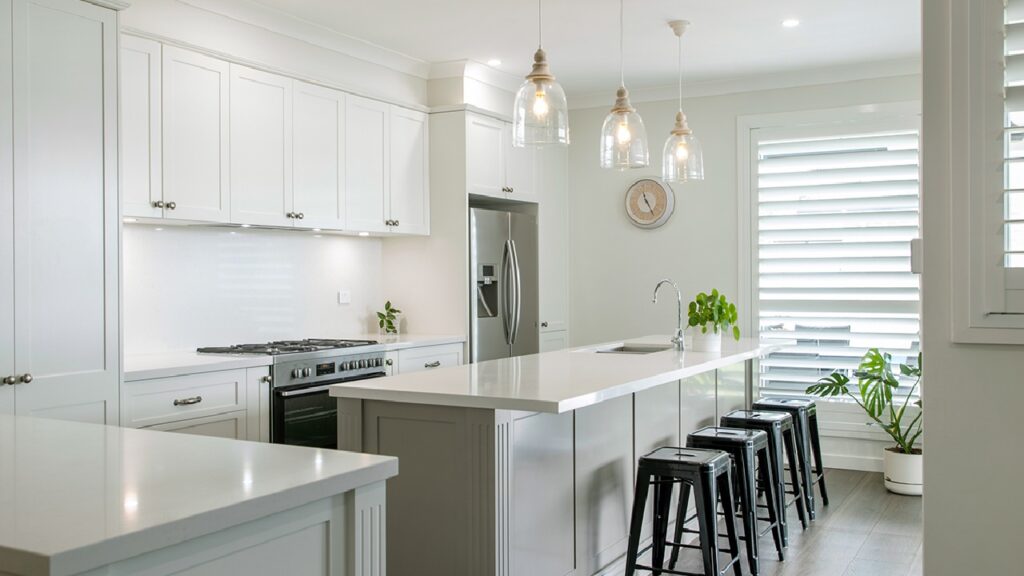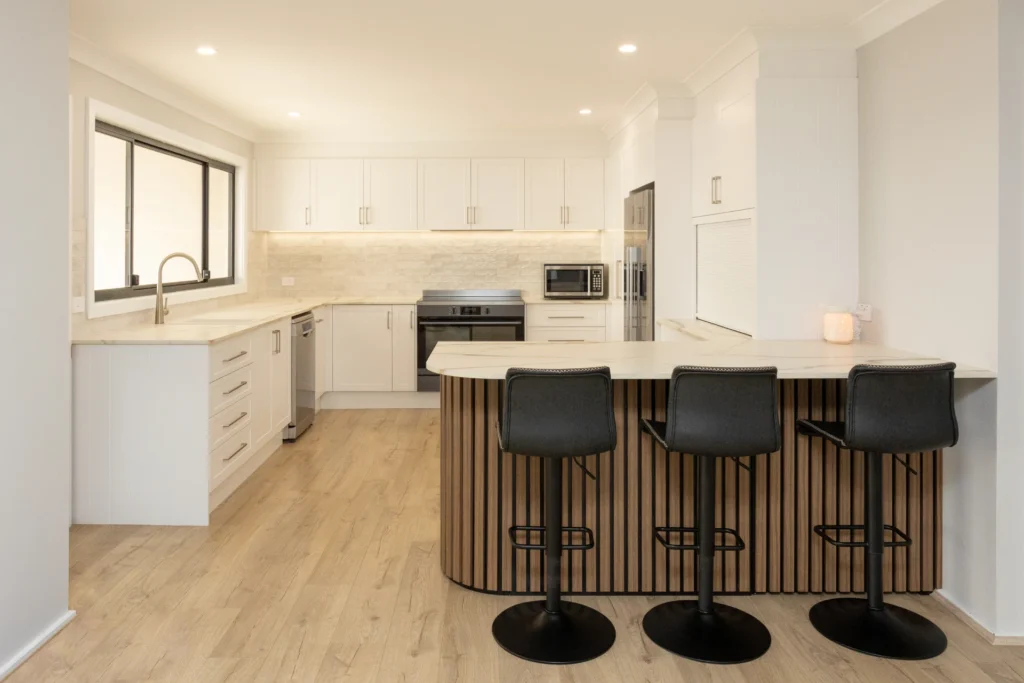


Modern kitchen cabinetry looks its best when the styling appears effortless.
Of course, “effortless” usually involves choosing the right door profile, finding two whites that don’t argue with each other, comparing hardware finishes and staring at stone samples from several different angles.
The good news is that there is a method to it.
If you want to know how to style modern kitchen cabinetry, these eight combinations show how colour, texture, hardware and surrounding materials can work together without overcrowding the room.
What gives modern kitchen cabinetry a polished look?
Well-styled modern cabinetry has a clear hierarchy.
One finish leads. A second material supports it. Smaller details such as handles, tapware and lighting provide contrast.
The cabinet fronts themselves are usually relatively simple, which is why flat-front or finely detailed profiles appear so often in modern kitchen designs.
Before looking at specific combinations, remember three rules:
- Repeat materials intentionally. A handle finish is more convincing when it relates to another element in the kitchen.
- Control the number of features. Strong cabinetry, dramatic stone and a patterned splashback do not all need top billing.
- Compare everything together. Cabinet colours can change significantly beside flooring, benchtops and natural light.
With those rules sorted, you can start building a combination that suits the room.
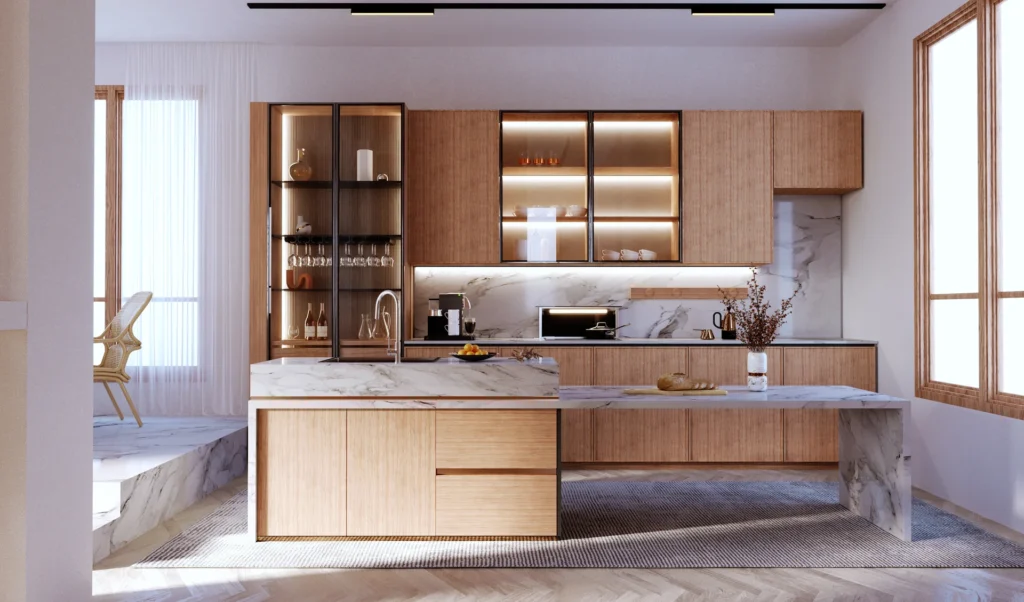
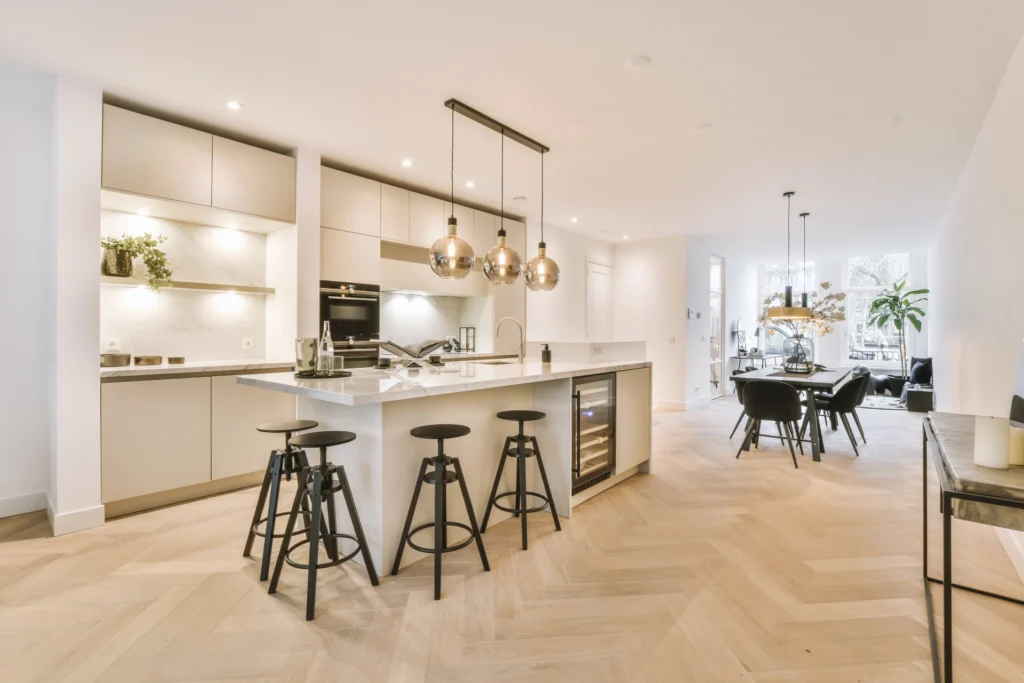
1. Warm white cabinetry with natural timber
Warm white and timber is one of the easiest ways to make modern cabinetry feel clean without making the kitchen feel clinical.
Use the white across the larger cabinet runs, then introduce timber on an island, overhead cabinetry or a bank of tall units.
The contrast comes from texture rather than bold colour, so the overall result stays calm.
This combination also gives you plenty of flexibility with the benchtop. Softly veined stone, pale neutral surfaces and warm greys can all sit comfortably beside it.
Planit Kitchens’ guide to contemporary kitchen colour schemes explores this warm-white-and-timber pairing as one of the schemes that continues to work well over time.
Works best with: pale stone, brushed nickel or matte black hardware, warm lighting and timber used in one or two defined areas.
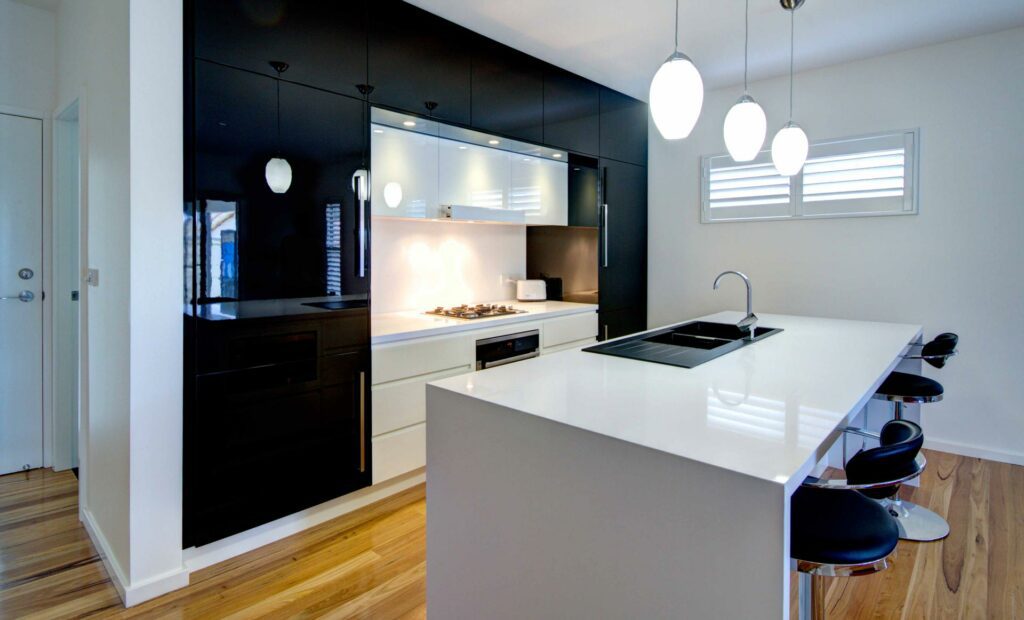
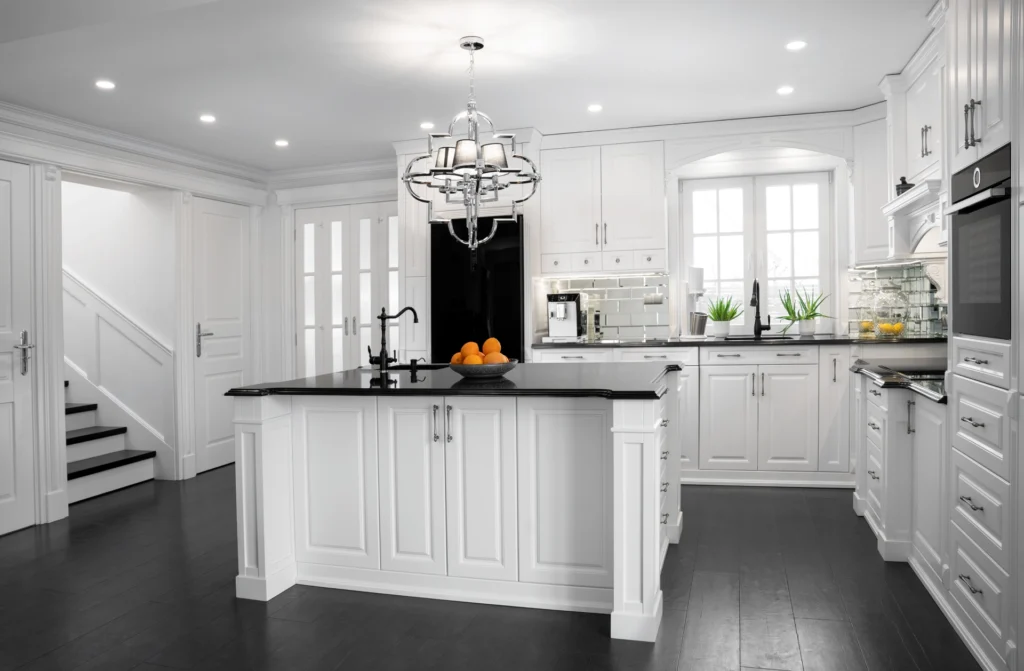
2. White perimeter cabinetry with a navy or charcoal island
If you like dark cabinetry but do not want an entirely dark kitchen, concentrate the deeper colour on the island.
The island naturally acts as a visual anchor, while white perimeter cabinetry keeps the outer walls feeling lighter.
Navy has slightly more colour than charcoal but still behaves almost like a neutral. Charcoal produces a sharper monochrome effect.
The balance is particularly useful when the island is already the room’s centrepiece. Rather than introducing another feature material, the colour itself can do the job.
A light benchtop can then connect the island back to the perimeter cabinetry.
Pairs best with: white or lightly veined stone, brushed brass for a warmer look, or matte black hardware for something more architectural.
3. Greige cabinetry with tonal stone
Not every modern kitchen needs strong contrast.
Greige cabinetry paired with stone in a similar tonal family creates a softer, more layered effect.
The key is texture.
If the cabinet colour and benchtop are close, use variation in surface finish, subtle veining and hardware to stop the room feeling flat.
A matte cabinet finish beside honed or lightly patterned stone can give the kitchen depth while keeping the palette restrained.
This works particularly well in a contemporary kitchen where warmth and softer finishes are part of the overall look.
Looks strongest with: tonal stone, subtle veining, brushed metal details and warm rather than stark lighting.
4. Timber cabinetry with simple stone
If timber is going to be the hero, let it be the hero.
Woodgrain already brings colour, pattern and texture, so it generally works best beside simpler surfaces.
A clean white, off-white or pale neutral benchtop gives timber room to stand out. Minimal hardware keeps the focus on the grain.
Watch the flooring carefully.
Timber cabinetry beside timber flooring can work, but the tones should feel intentionally related. Two competing woodgrains can make the room look much busier than expected.
If possible, compare both materials in the same light before committing.
Works best with: quiet stone, restrained handles, plain splashbacks and flooring that complements rather than competes with the cabinet grain.
5. Coloured cabinetry with a simple splashback
Muted greens, deep blues and earthy shades can give modern cabinetry much more personality.
But once the cabinetry becomes the feature, the surrounding finishes need to know when to stay quiet.
This is particularly important with the splashback.
Planit Kitchens’ guide to contemporary kitchen splashback ideas recommends deciding whether the splashback should blend into the design or become the focal point. With stronger coloured cabinetry, letting it blend is often the better move.
Simple stone, tonal tiles or restrained glass can support the cabinets without starting a second conversation.
Pair it with: simple splashback materials, understated stone and hardware that either repeats the cabinet tone or provides one clear contrast.
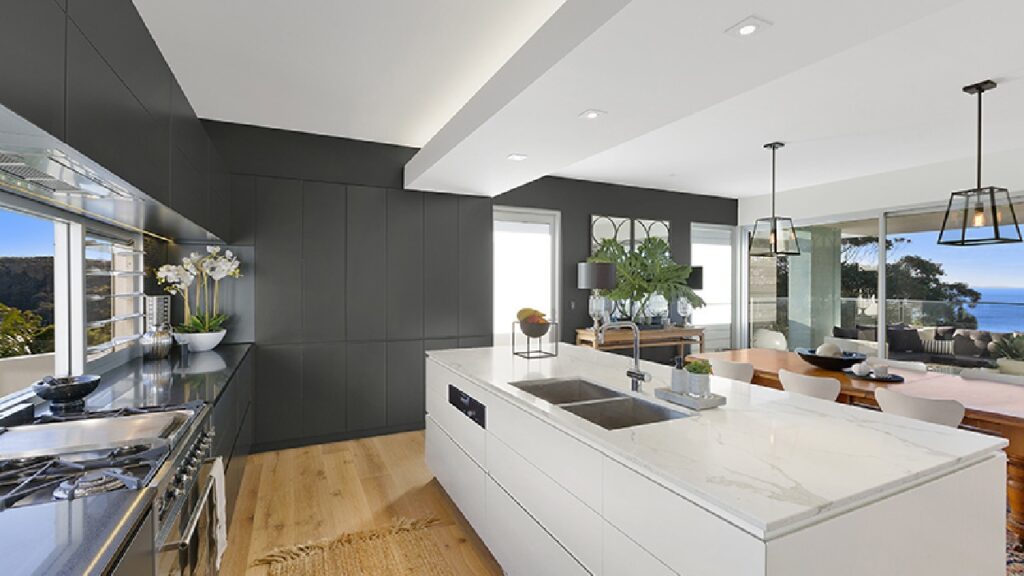
6. Flat-front cabinetry with statement stone
Sometimes the cabinetry should step back.
Flat-front doors in a quiet colour create the perfect background for a more dramatic benchtop or splashback.
Strong veining works especially well here because the cabinet fronts do not introduce another pattern.
If you continue the same stone vertically as the splashback, the result can become even more seamless.
Keep handles restrained so there are not too many visual breaks across the cabinetry.
This is one of the easiest ways to create a modern kitchen with impact without adding lots of different colours.
Best paired with: slab-style cabinet fronts, simple handles or recessed pulls and one stone chosen as the main visual feature.
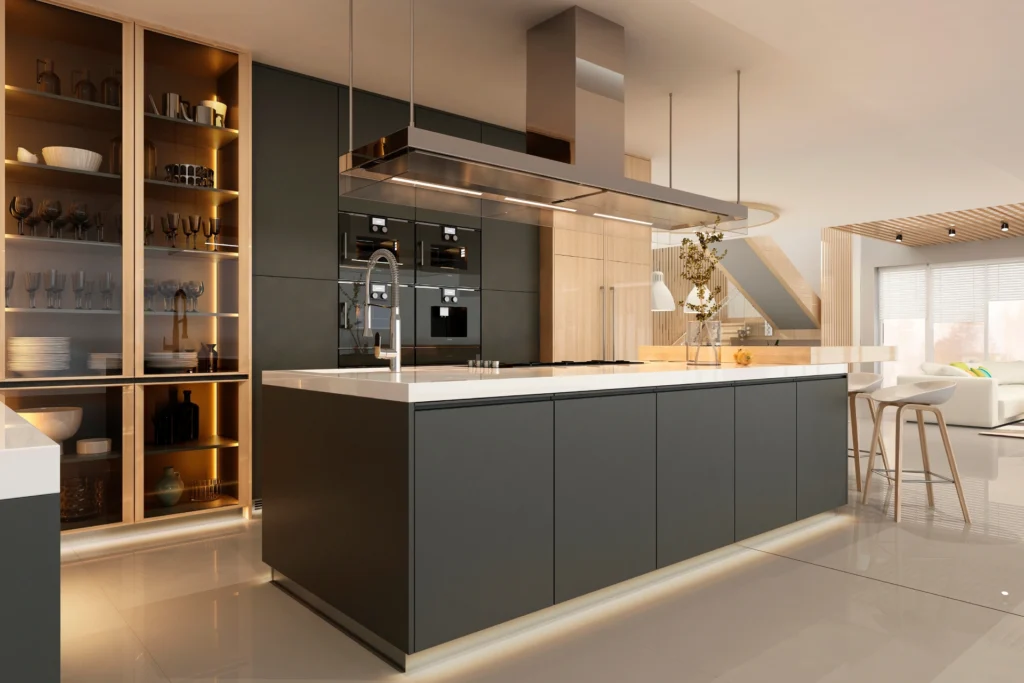
7. Handleless cabinetry with integrated appliances
Handleless cabinetry creates some of the cleanest lines in modern kitchen design.
Finger pulls, recessed rails and integrated channels allow cabinet fronts to remain largely uninterrupted.
Integrated appliances can continue that effect by concealing the dishwasher or fridge behind matching panels.
The important part is usability.
Test the opening mechanism before using it across an entire custom kitchen. A minimal detail is only successful if it is comfortable to use.
Push-to-open systems can work well in some areas, while frequently opened drawers may benefit from a more tactile solution.
Works best with: integrated appliances, consistent shadow lines, simple surfaces and opening systems tested for real everyday use.
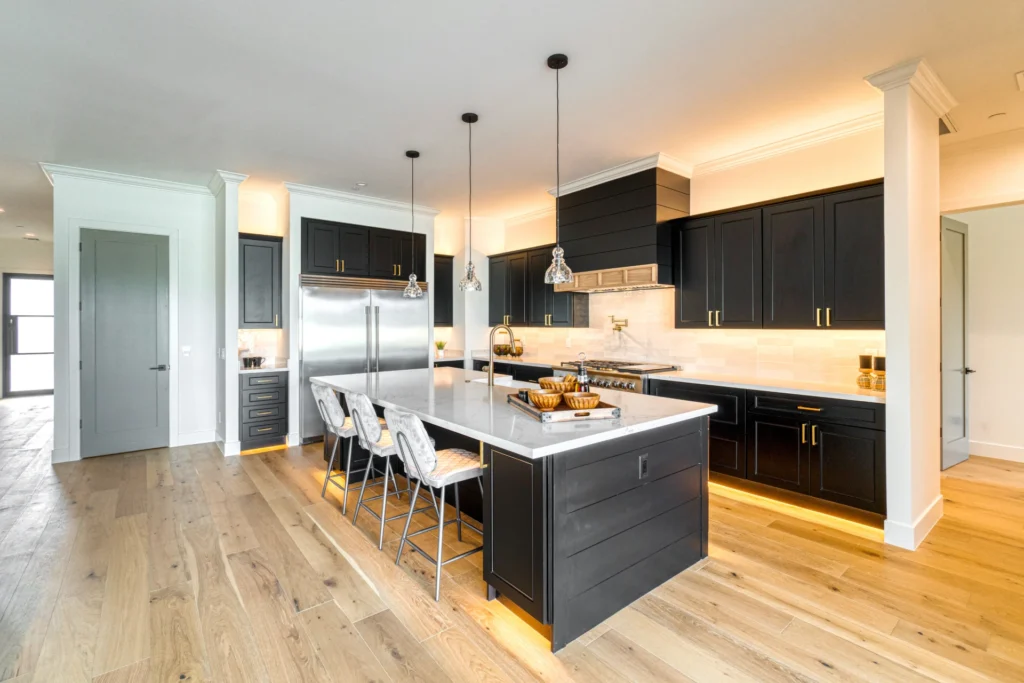
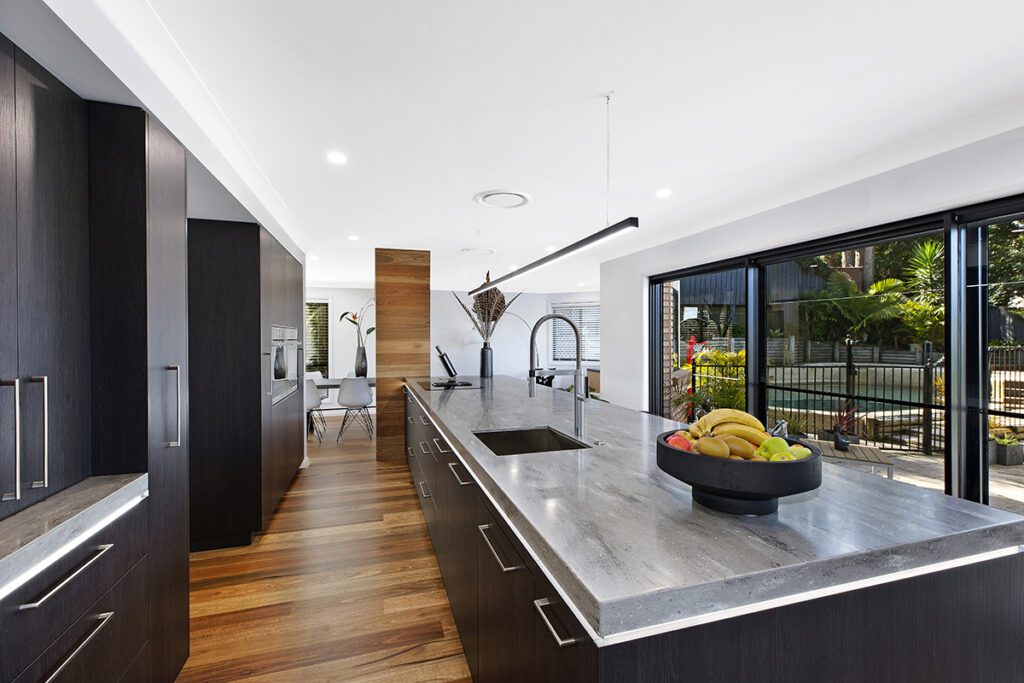
8. Dark cabinetry with warm metallic details
Black, charcoal, forest green and deep navy cabinetry can create a confident modern kitchen.
Warm metallic details stop those darker colours feeling too severe.
Brushed brass or aged-bronze handles can bring warmth, while stainless steel or gunmetal creates a cooler and more architectural result.
Lighting becomes especially important with dark cabinetry because deeper colours absorb more light.
Under-cabinet lighting can brighten the work surface, while pendants above an island can repeat the hardware finish to make the material palette feel deliberate.
Best suited to: kitchens with good natural or artificial light, pale benchtops and metallic accents repeated selectively rather than everywhere.
Which cabinetry combination suits your kitchen?
Use the room itself to narrow the options.
| If your kitchen has… | Consider… | Why it works |
|---|---|---|
| Limited natural light | Warm white + timber | Keeps large surfaces lighter |
| A large central island | White perimeter + dark island | Creates a natural focal point |
| An understated interior | Greige + tonal stone | Adds depth without strong contrast |
| Plenty of daylight | Dark cabinetry + warm metal | Allows deeper colours to hold their own |
| Feature stone | Simple flat-front cabinets | Stops materials competing |
| Strong timber flooring | Painted cabinetry | Avoids too many competing grains |
| A minimalist interior | Handleless cabinetry | Maintains uninterrupted lines |
This is also where seeing materials physically becomes useful.
At a kitchen showroom, you can compare cabinet finishes, stone and hardware at a more realistic scale than a collection of small digital swatches.
How do you style handles without overdoing them?
Treat hardware as part of the palette.
You do not necessarily need every metal finish in the kitchen to match exactly, but there should be a relationship between them.
For example:
- Brushed brass: Works particularly well with navy, green, timber and warm neutrals.
- Matte black: Creates stronger contrast against pale cabinets and blends into dark cabinetry.
- Brushed nickel: A quieter choice for white, grey and timber palettes.
- Stainless steel: Can connect cabinetry with visible appliances.
- Gunmetal: Works well in darker, more architectural schemes.
Handle size matters too.
Very small hardware can look lost on wide drawers, while oversized pulls can dominate compact cabinet fronts.
Quick rule: choose hardware after the cabinetry and benchtop, not before them.
How much open shelving should modern cabinetry have?
Usually less than social media would have you believe.
A short run of open shelving can break up overhead cabinetry and provide somewhere for ceramics, glassware or a few decorative pieces.
Too much open storage means the practical contents of your kitchen become part of the visual scheme.
That may be fine if your cereal boxes have excellent design discipline.
For everyone else, keep most practical storage behind cabinet doors and use open shelves as a small styling feature.
Works best with: a short timber or painted shelf, a restrained number of objects and plenty of closed storage close by.
What makes modern cabinetry look expensive rather than busy?
Restraint.
That does not mean everything needs to be neutral.
It means giving each feature enough space to register.
Before approving the cabinetry, ask:
- What is the main feature? If the answer is cabinetry colour, stone, timber and handles all at once, edit something back.
- Are the undertones compatible? Compare cabinetry against flooring and stone in the same light.
- Does the hardware repeat another finish? Repetition makes the design feel deliberate.
- Is there somewhere for the eye to rest? Large runs of simple cabinetry can be just as important as feature areas.
- Will the storage still work? A beautiful exterior should not hide an impractical interior.
The strongest modern cabinetry often looks straightforward.
That is usually because the difficult decisions have already been resolved.
Start Planning Your Modern Kitchen Cabinetry
Styling modern cabinetry is about finding the right balance between colour, texture, proportion and practical storage.
With more than 33 years of experience, Planit Kitchens designs, manufactures and paints custom cabinetry for kitchens across the Central Coast, Newcastle and Sydney.
- Explore our custom kitchen designs
- Compare cabinetry and materials at our Central Coast kitchen showroom
- Ready to talk cabinetry? Get in touch with our team